This First Friday Lecture is supported by gifts made in memory of Basic Program Instructor Claudia Traudt.
What equips us – intellectually and emotionally – for open-mindedness? Is open-mindedness a virtue of the self’s core or of its periphery? How does open-mindedness affect our need for certainty, consistency, and safety?
One facet of this big topic is the self’s multiplicity, poetically defined by Walt Whitman: “Do I contradict myself? / Very well then I contradict myself, / (I am large, I contain multitudes.)” While multiplicity can be observed in a variety of human endeavors, our awareness of it is rarely acute. In fact, we habitually try to avoid the discomfort of contradicting ourselves or of not being able to find a unifying logic to other people’s behaviors or thinking. Consequently, we may reduce our vision of the world or the story of our own lives to what seems to “make sense.”
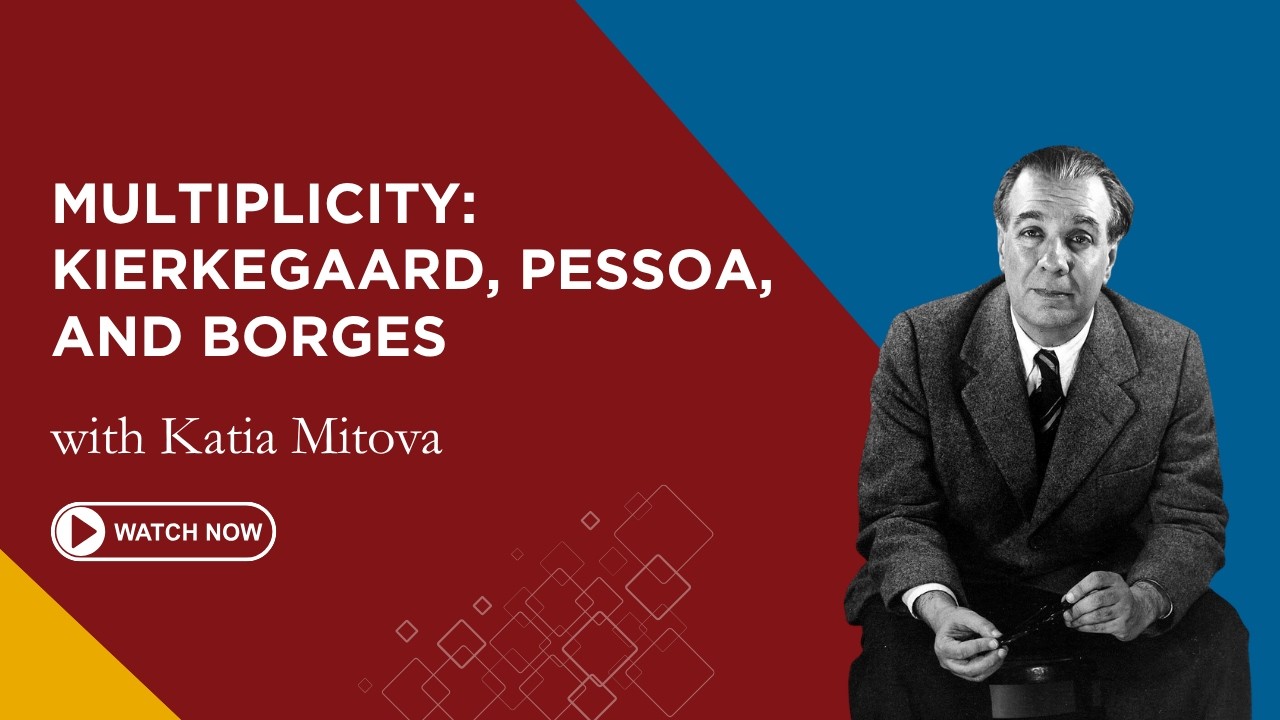
This lecture is an invitation to a closer look at some influential thinkers and artists who lived their personal multitudes to the fullest. How did they deal with incongruity and uncertainty? Did they benefit from embracing their own multiplicity? Danish philosopher Søren Kierkegaard (1813-1855) and Portuguese modernist Fernando Pessoa (1988-1935) expressed contradictory thoughts and feelings by assigning them to distinctly different creative personalities. This allowed them to preserve their expanding selves unbound, to practice open-mindedness in limiting social and cultural environments. To Argentine Jorge Luis Borges (1899-1986), on the other hand, multiplicity was a natural state of the mind – his self’s multitude had the unity of a librarian inhabiting an inclusive depository of ideas and idiosyncrasies.


