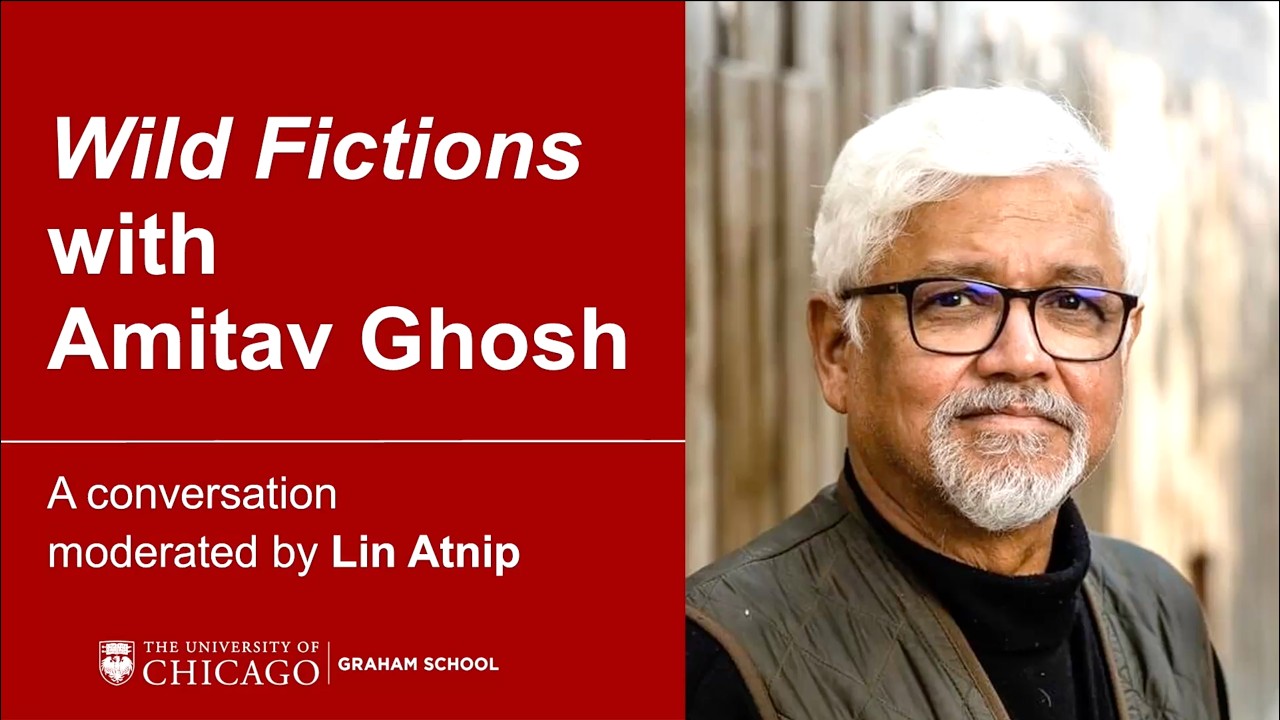
Award-winning author Amitav Ghosh joins the University of Chicago’s Graham School for an evening conversation moderated by instructor Lin Atnip. The discussion centers on Ghosh’s essay collection Wild Fictions, published by the University of Chicago Press, spanning roughly 25 years of thinking on colonialism, biodiversity loss, and the search for narratives capable of meeting this moment. His earlier book The Great Derangement serves as a recurring reference point.
Ghosh traces how his thinking evolved from a 1999 essay written before researching The Hungry Tide in the Sundarbans, where witnessing vanishing crabs and depleted birdlife first sharpened his sense of an unfolding polycrisis. He reflects on fiction vs. nonfiction through the analogy of pottery, and moves through the rupture in modernity’s promise of endless growth, mimetic desire driving consumption across the Global South, and Gandhi’s early warning that an industrialized India would exceed planetary limits.
He argues that one of the central challenges facing writers today is recovering nonhuman agency, largely abandoned by the 19th-century novel. Whale behavior, trees communicating in forests, and the opium poppy each serve as examples of the agency literature is uniquely positioned to voice. He also addresses the fiction of pristine nature, the violence of displacing indigenous peoples in its name, from Yosemite to the Ngorongoro crater, and the Amazon’s history as something closer to a garden than a wilderness.
About the Speaker:
Amitav Ghosh was born in Calcutta and grew up in India, Bangladesh, and Sri Lanka. He studied in Delhi, Oxford, and Alexandria and is the author of The Circle of Reason, The Shadow Lines, In An Antique Land, The Calcutta Chromosome, The Glass Palace, The Hungry Tide, the Ibis Trilogy (Sea of Poppies, River of Smoke, and Flood of Fire), and The Great Derangement. His most recent book is Wild Fictions (2025). His work has been translated into more than thirty languages. He holds five Lifetime Achievement awards and six honorary doctorates, and has received the Jnanpith Award — India’s highest literary honor, the first time it was given to an English-language writer — the Padma Shri, the Erasmus Prize, and election to the American Academy of Arts and Sciences. In 2019, Foreign Policy named him one of the most important global thinkers of the preceding decade.


