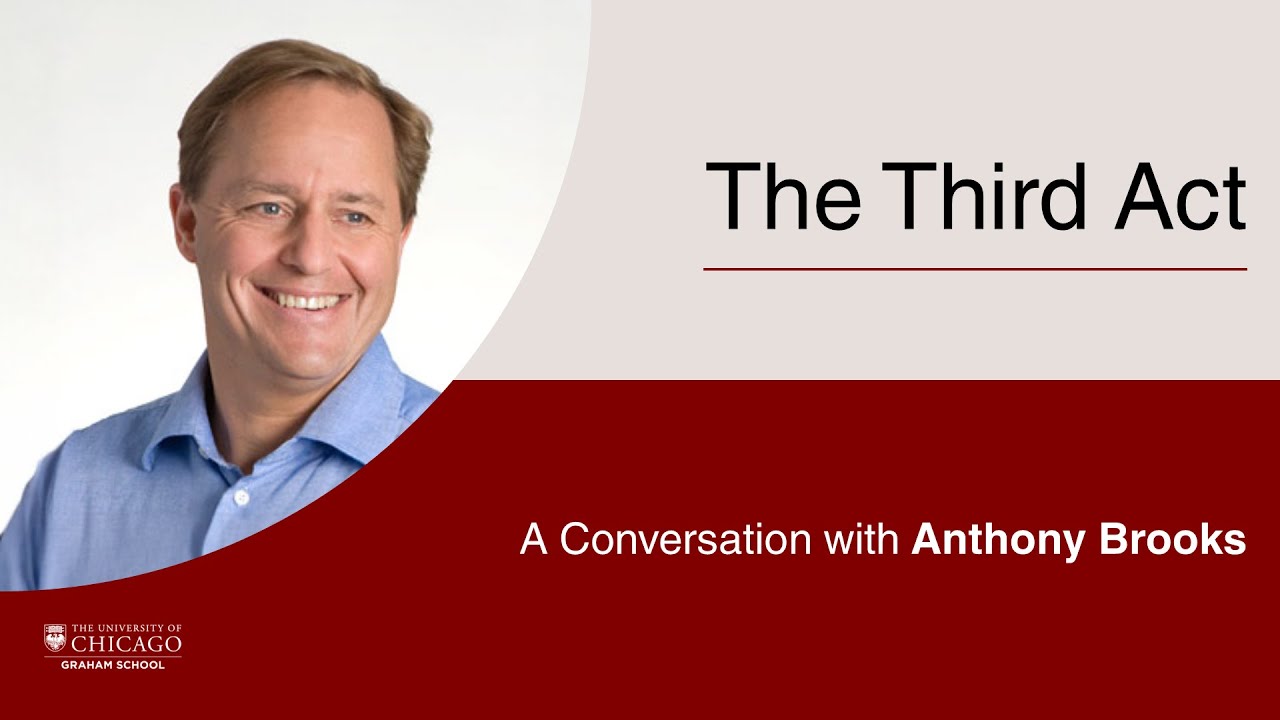
What does it mean to reinvent ourselves in the “third act” of life—and how can this chapter become one of even greater generativity and purpose?
This fireside conversation with veteran journalist Anthony Brooks draws on stories from his insightful reporting for WBUR’s The Third Act series. We also explored the motivations, challenges, and possibilities that come with launching new acts in midlife and beyond.
Lecturer bio:
Anthony Brooks brings more than 30 years of experience in public radio, working as a producer, editor, reporter and host for WBUR and NPR.
Before becoming WBUR’s senior political reporter, Brooks was co-host of Radio Boston, WBUR’s local news and talk show. For many years, Brooks worked as a Boston-based reporter for NPR, covering regional issues across New England, including politics, the economy, education, criminal justice and urban affairs. During the 2000 presidential election, he was one of NPR’s lead political reporters, covering Vice President Al Gore’s campaign from the early primaries through the Supreme Court’s Bush v. Gore ruling. His reports have been heard for many years on NPR’s Morning Edition, All Things Considered and Weekend Edition.
Beyond NPR, Brooks was also a senior producer on the team that launched “The World” for Public Radio International. He was also a senior correspondent for InsideOut Documentaries at WBUR. His documentary, “Testing DNA and The Death Penalty-InsideOut,” won the 2002 Robert F. Kennedy Award for best radio feature.
Over the years, Brooks has won numerous other broadcast awards, including the Edward R. Murrow Regional Broadcasters Award, the AP Broadcasters Award, the Ohio State Award and the Robert L. Kozik Award for environmental reporting for his Soundprint documentary, “Chernobyl Revisited.”
Brooks also has been a frequent fill-in host for NPR’s On Point and Here & Now, produced by WBUR.
In 2006 Brooks was awarded a Knight Wallace Fellowship at the University of Michigan, where he spent a year of sabbatical studies focusing on urban violence and wrongful convictions.
Brooks grew up in Boston, Italy and Switzerland, but he says none of those places have anything over Somerville, where he currently lives.
Transcript:
Seth Green: Welcome to everyone. We are thrilled to have you here for the 3rd act, a conversation with Anthony Brooks. My name is Seth Green, and on a morning like this one I’m especially grateful to say I’m the Dean here at the Graham school at the University of Chicago, and I want to welcome you to our gorgeous campus this morning, a place where big ideas are born that continue to shape and reimagine the world. And I am grateful to welcome you to the Graham school in particular, where we are now 134 years young in our mission for promoting lifelong learning, a topic that we will be going into today as part of the journey for discerning a 3rd act. I’ll just call your attention that we have many other exciting conversations coming up. Next month we will have a fireside chat with Michael Fashnot, who is our leader for the Chicago leadership circle about how individuals and institutions can be part of really contributing to the economic community development of our region. We will have our Graham School Annual report, where you can not only hear about what happened in the last year, but more importantly, shape what’s happening in the year ahead. And we’ll have our basic program info session toward the end of next month. And I also just want to note that summer courses are open. You can see in the chat momentarily, the opportunities in September for the 3 week term that we have that still have availability. But the reason you are all here and I’m going to take down my screen is for our conversation with Anthony Brooks. Anthony brings more than 30 years of experience in public radio working as a producer, editor, reporter, and host for Wbur and Npr. Before becoming Wbur Senior political reporter. He was co-host of Radio, Boston. He was also a senior producer on the team that launched the world for public Radio International. Over the years he has won many awards, including the Edward R. Murrow, regional broadcasters Award, and the Ap. Broadcasters award. And today we are talking with him about his series on the 3rd act, which we found fascinating. And so, Anthony, I want to get started by asking you what drew you to reinvention in midlife and beyond, and led you to build this really important series for Wbur.
Anthony Brooks: Oh, well, thanks, Seth, and thanks for having me, and good question to kick things off. I mean, you know. I guess I’m sort of a restless soul. I think I’m even though I’ve been, you know, 40 years in this career. I’m still always sort of trying to figure out what I want to do when I grow up. So I think that’s sort of at the base of this. I mean, I just love the idea of reinvention, and I guess about 15 years ago, you know, I started paying attention to stories about people who managed to reinvent themselves in interesting and inspirational ways. Later in life I’d gone through a health scare. My dad had died. They all felt like sort of flashing yellow lights of middle age, you know reminders that a lot more life is behind us than ahead of me. And so I started thinking about the best way to live out. You know what was left, and this curiosity drew me to these stories, and I want to give credit to a colleague from the New York Times, named Kit Seeley. She wrote a wonderful story about a guy named Tom Andrew, who was a medical examiner in New Hampshire. He had a full career as a doctor, including 20 years as the State’s chief medical examiner and he got to a point where he just had enough. He was overwhelmed by the opioid addiction crisis. He was tired of looking at dead bodies of young people, and he just had enough. But he wasn’t ready to stop working. So he enrolled in seminary school to become a Methodist deacon and youth pastor, and he did that in his mid 60 s. And you know, as he’s told me, he was done with his medical profession, but he still had plenty of energy and passion left. So by the time I had done the story, I did the story on him a couple of years back. You know, he was ministering to his local Boy Scout Troop in New Hampshire, and really found a new purpose in his life. So I think it was stories like that that drew me to other stories. And that’s when I got the idea to launch a series, because there’s a whole bunch of data about how we’re living longer, and a whole bunch of other stuff that we can talk about as this conversation continues. But it turns out a lot of people are doing what Tom Andrew did, and that just really intrigued me. And I wanted to get at who these people were and why they were doing it.
Seth Green: Well, so you’ve talked to a lot of people, looked into their stories, told them beautifully. I want to go through some of them, but before we jump into specific examples, I want to get your high level on. What are the themes that you saw consistently showing up across individuals who had successful 3rd acts.
Anthony Brooks: Yeah, I mean, I think it’s this idea that Tom Andrew expressed that he’d sort of come to a natural end of his normal career, but still had plenty of gas left in the tank, and with that gas he could fuel the next chapter that might not have anything to do with his 1st career. You know, and there’s some interesting facts and trends that underlie all of this. One of them has to do with life expectancy. A little over a century ago the life expectancy in the U.S. Was about 47 years today. It hovers around 80. So that means we’ve added 30 years of life to the average life. If you’ve got a little bit of good health on your side, maybe some good genetics on your side. That means the traditional idea of 3 stages of life. Learning, earning, and retiring is really outdated, and instead, lots of people like Tom Andrew are discovering that life can reset. At age 50, 60, 70, or even later.
And there’s this interesting and I think, inspiring idea that people who study this phase of life talk about. And it’s called middlescence, and like adolescence, middlescence can be a time of change and tumult later in life. But it’s also an opportunity for growth. And it’s important to think about these extra years not as more years to be old, but rather an extension of that middle phase of life where you can still be active and create something new. So, for example, for this series, I interviewed Sarah Lawrence Lightfoot. She’s a professor of education at Harvard, and she wrote a wonderful book which really helped me do this series. It’s called The 3rd Chapter: Passion, Risk, and Adventure in the 25 Years After 50, and she interviewed dozens of folks like Tom Andrew, who chose new careers or adapted new skills later in life.
And the way she talks about this form, this phase of life is incredibly, potentially, incredibly generative and transformational. Maybe the most transformational time in our lives if we take advantage of it. And by this period of life she’s talking about the years between 50 and 75. So that was sort of the, you know, that had a lot to do with the focus of my stories.
Seth Green: So let’s go into some of the stories. Were there any that particularly surprised or moved you? And can you tell us a couple, and then we’ll go through a little bit deeper into kind of saw play out.
Anthony Brooks: Well, you know, one of the things I was aware of is that you know you can talk about this idea of a 3rd act of applying only to a sort of certain socioeconomic set of people, if you will, that is, people who have the means to sort of stop working and reinvent themselves and do something later in life. And that’s not always easy for everybody. But what I discovered is that there are a lot of wealthy people who are doing this. There are people who are not as wealthy who are figuring out a way to do this as well, and one of the stories I looked at was about a woman named Natalie Jones. She grew up in Boston when I interviewed her a few years back. She was 76.
She grew up working class in Boston, the granddaughter of Italian immigrants, and she was raised with the belief that she just wasn’t smart enough to go to college. That was pretty much the conversation around the dinner table growing up, and as a young adult she got married. She had 2 kids. She found herself. Then she was divorced. She found herself struggling as a single mother, working a succession of low paying jobs. Eventually she found herself attending counseling sessions for single parents like her, and she began volunteering to help run these sessions, and she discovered she was pretty good at talking to people and helping them through the kind of challenges that she was dealing with, and at the age of 59 she finally sort of overcame this belief that had been sort of hammered into her that she’s not smart enough to go to college, and she went to college. And then she went on to graduate school, and she earned a Master’s degree in social work, and began a new career as a social worker in her early sixties, and told me that you know. She plans to keep on working well into her eighties.
So that’s a story that I just love of someone who really, really reinvented themselves, you know, in this later phase of life, and it certainly wasn’t ordained that she was going to be going in this direction. It took a real effort on her part. But it was a wonderful story of reinvention, and the last time I visited her she was sort of living the dream, and had bought a Condo, on the south shore south of Boston, with a view of the ocean which had been her lifelong dream and sort of a lovely story.
Seth Green: A lovely story, and I want to now walk through how to engage a 3rd act, because you’ve seen a lot of people do it like Natalie. And I want to start where individuals start, which is some sense that it may be the right time to take a leap into something new. And you’ve described this already, Anthony, at a high level, that some individuals may feel like they have a readiness to finish their longstanding career, but still have gas in the tank. I imagine there are other ways, though, that people come to this discernment, that it’s time for something new. Can you talk about step one of these processes, which is the discernment that a change or an entry into this middlescence may be an important feature for them, and how people come to that sense in their 50s, 60s, 70s?
Anthony Brooks: Yeah, yeah. Let me throw this out as well, because there’s sort of some facts that kind of back this up—I mean, why so many people are doing it. You know, Seth, right before we started this conversation, we were talking about 10,000 baby boomers reaching retirement age every day. But a lot of them aren’t ready to stop working, either because they can’t afford to, like Natalie Jones, or like Tom Andrew, because they don’t want to. You know?
So if you look at someone age 65 or older now—this comes from Richard Johnson, who’s a senior fellow at the Program on Retirement Policy at the Urban Institute—he tells me that if you look at someone age 65 or older now, that person is 75% more likely to be working than someone who was in the same age group a generation ago.
Seth Green: Wow!
Anthony Brooks: So 75% more.
Seth Green: Number of people in that category who are working.
Anthony Brooks: Yeah. And according to the U.S. Census Bureau, the number of Americans living into their nineties in 2050 is expected to be four times higher than it was in 1980. So that’s an extraordinary number—just tons of people living into their nineties who just weren’t doing so before. So if you’re 45, you may have half your life ahead of you. So I think that kind of creates this moment—or this increasingly frequent moment—of people getting into this…
But I’m sorry, you asked me a question. Yeah, no—so your question… I can’t remember what the question was.
Seth Green: So how do people come to this discernment? Part of it, to your point, is they realize they have a lot of time left, and they want to use that time. I mean, I think it’s very different if you’re reaching 65 and say, “I have 10 years.” In that case, the idea of reinvention can feel really difficult—because you might think, by the time I go through college and a master’s program, I’m done. I’m not going to use this degree.
But if you expect to live to 90 or 95, that’s a totally different equation. Suddenly, it might make sense to go after that bachelor’s degree you’ve always dreamed of, because you’ll have time to use it. So that’s definitely a big piece of the puzzle—the horizon people are imagining is longer, and it arguably allows for two acts now.
But I want to go deeper, because I think there’s more to it than just the timeline. I think there’s also this yearning that you’re describing. I’m curious—how do people come to imagine that they could do something different? Across the people you’ve spoken to, have you seen a common spark or catalyst?
Anthony Brooks: Yeah. The people I interviewed all shared this wonderful sense of satisfaction in their third acts—because, in a way, they were doing it for the right reasons. In most cases, their kids had grown up, they’d already done a full career, so they didn’t have anything left to prove. That gave them space to really focus on work that had deep meaning for them.
They brought a sense of wisdom, and in many cases, a desire to give back. They weren’t working to fulfill a quota or maximize a paycheck—they were working to express their passion and sustain their souls. That’s something I saw again and again.
If you’ve worked one career for 25, 30, even 40 years, it can be incredibly liberating to move on to something new. That’s what I found in talking to these folks—they had reached a point where they were ready to live a dream they hadn’t yet been able to pursue. It was really inspiring to spend time with them and hear those stories.
Ultimately, it comes down to this: they had lived one part of their productive adulthood, and then they got to a point where they had the courage and the wherewithal to take the plunge—to do something their soul was really calling them to do.
Seth Green: Before we jump into the benefits and satisfaction you’re describing, I do want to look at the challenges. I know from talking to a lot of people engaging in third acts that even when they end up really satisfied, the process can be emotionally trying.
You referenced “middlescence”—and like adolescence, it can be a turbulent time. I remember adolescence. I have happy memories now, but I’m convinced that’s just my memory playing tricks on me, because during those years, it wasn’t always joyful.
Can you talk a little bit about middlescence and what some of the emotional challenges and barriers are when it comes to starting over later in life?
Anthony Brooks: Yeah, well, I think “challenge” is absolutely the right word—because for a lot of people, this is a difficult transition. You’re leaving behind something you’ve become very good at, something you have deep experience in, and you’re taking on something new. In many ways, you’re starting from the beginning.
Take Tom Andrew, for example. To become a Methodist deacon in his early sixties, he had to go back to school. He enrolled in seminary, sat for exams, and went through a whole series of interviews with church leaders. He also faced frustration with church bureaucracy. This was a guy who had once run his own office as the state’s chief medical examiner—and suddenly, he had to go back and be humble. At the same time, he says his third act ended up being quite liberating.
Sarah Lawrence-Lightfoot, the Harvard education professor who wrote about third acts, talks about this stage as potentially liberating, too—but also difficult at the outset. Because these third acts require a leap into the unknown.
And for older adults, that leap can feel particularly daunting. They face the challenge of learning new skills and possibly giving up status. You go from being an experienced elder to becoming, in a sense, an “older beginner.” But really, what it comes down to is this: stepping into a third act requires risk-taking, and it requires vulnerability. When you’re willing to do that, the reward on the other side can be deeply fulfilling.
Seth Green: One thing I know you’ve explored is the role of community, mentorship, and the people around us in shaping this journey. How do those forces help support individuals in navigating this transition—both in imagining what’s next and in activating that vision?
Anthony Brooks: That’s a great question—I have to think carefully about it. Because honestly, the sense I got from many of the people I interviewed is that they were often pushing back against what their communities expected of them.
We still live in a world where there’s this general assumption that retirement means beginning a slow decline toward the end of life. So these individuals were, in many ways, resisting that narrative. They were pushing against the norm.
Take Natalie Jones—she grew up in an environment where people told her outright, “People like us don’t go to college.” So she was expected to give up on that dream. But she didn’t.
That’s what I saw repeatedly—people stepping into their third acts often had to push against limiting expectations from the world around them. They had to take a leap, embrace some humility, and be willing to start over. Because even if you’ve been at the top of your profession, starting something new is humbling.
But that’s part of the journey—accepting the discomfort and pushing forward anyway, because of what that next chapter might hold. Does that make sense?
Seth Green: That makes total sense. We have a professor here—Harry Davis—who teaches at our Booth School of Business and also in the Leadership & Society Initiative, which supports individuals in navigating transitions into meaningful next chapters. He uses this analogy of traveling lightly.
He says, when you’re going to a new destination, you can’t take everything with you—or you’ll be weighed down by the baggage. But you also don’t want to travel naked. So the key is being intentional: What identities, assets, and skills do I want to bring with me? And what do I need to let go of?
One of the biggest challenges, especially for people with a long and cherished identity, is knowing when to release that identity—even if it’s served them well up to this point. It can become like a warrior’s shield—something they feel they need to carry into their next chapter. But sometimes, that identity no longer serves them.
Harry’s analogy actually comes from personal experience. He was a marketing professor and later became Dean at Booth. When he returned to being a faculty member, he had to move back into his old office—and he realized he didn’t have room for all his books. He decided not to bring his marketing books, even though that was his career for decades. Instead, he brought only leadership books, because that’s what he wanted to focus on moving forward. It helped him fully embrace the next 30 years of his academic journey. But at the time, letting go of those books—and all they represented—was very difficult. As you might imagine, for an academic, books are a big deal.
Anthony Brooks: That’s such a compelling analogy—traveling lightly. It reminds me of another story I reported on, a great example of a third act: Juliana Richardson.
She’s an incredible woman based in Chicago who founded The HistoryMakers, an ambitious oral history project collecting audiovisual stories of Black Americans. She’s interviewed everyone from Ernie Banks to Barack Obama to Maya Angelou—it’s a truly impressive archive.
Her story really resonates. Juliana grew up as a Black girl in rural Kansas and was painfully aware from a young age that her own history and identity weren’t reflected in the world around her. That absence stuck with her—and she carried it with her into college at Brandeis.
But she followed a very different track at first. Her father wanted her to become a lawyer, so she went to Harvard Law and became a corporate attorney in Chicago. She never felt at home in the corporate world, but she stuck with it for years. Eventually, she hit a classic midlife crisis—she simply couldn’t do it anymore.
She left the corporate world and tried being an entrepreneur, including launching a home shopping network in Chicago. It didn’t succeed—largely because the cable industry was in flux at the time. But what some might call a midlife crisis, she used as a moment of reinvention.
She returned to the passion she had carried since childhood: telling stories that hadn’t been told. She founded The HistoryMakers to address that gap she felt growing up. Now, it’s a massive collection housed in the Library of Congress and available at universities nationwide. She made that shift in her mid-to-late 50s—and she’s never been happier.
It’s such a powerful example of how this period—what some call “middlescence”—can be transformational.
And one of the people I interviewed, Barbara Waxman—a gerontologist—takes issue with the whole notion of a “midlife crisis.” To your earlier point, Seth, we don’t talk about adolescence as a crisis, even though it’s full of turmoil. We recognize it as a transition—a churning moment that helps people become who they are meant to be.
Barbara sees middle age the same way. It’s not a crisis—it’s a productive transition. A period of change we can harness to step into new expressions of purpose and passion.
Seth Green: Anthony, I think you’re describing a really common experience—and you touched on this earlier when you talked about community—of individuals trying to overcome the expectations that have been put on them and instead tune into their own inner guide for motivation.
David Brooks, who also teaches with us, talks a lot about this in his book The Second Mountain. He writes about the idea that people often need to move beyond their “first mountain”—the one defined by societal expectations or others’ ambitions for them. That might be becoming the corporate lawyer your parents envisioned, or hitting conventional milestones of success. But the second mountain is about identifying and pursuing your own values and purpose.
And here’s the challenge: if you’ve spent 20, 30, even 40 years achieving traditional markers of success, it can be really difficult to shift. You’ve built an identity around external validation and performance. So how do you then develop an internal locus of motivation and meaning?
You mentioned Juliana Richardson as someone who sort of fell into that valley—she left corporate law, her entrepreneurial venture didn’t take off, and only then did she reconnect with her passion and purpose. I’m curious: Have you seen people arrive at their third act in ways that don’t require a crisis moment or major breakdown? Are there gentler, more intentional ways people come to this kind of transformation?
Anthony Brooks: That’s a great question. Juliana Richardson’s story is definitely one of dramatic reinvention—she completely shifted direction and now does something entirely different from her earlier career.
But not everyone’s story is like that. One idea that stuck with me while reporting this series was something a source said: “It’s the same seed, but a different plant.” That resonated with me. Many of the people I interviewed didn’t actually abandon who they were—they found new ways to express long-held values or gifts.
Take Tom Andrew, for example. He was a doctor—a healer—and his third act was to become a Methodist deacon. It’s a different role, yes, but the underlying impulse is the same: helping people. He was particularly focused on reaching young people, especially after seeing firsthand the damage caused by opioid addiction. He wanted to offer support and guidance before those young people ever turned to drugs in the first place.
So in that case, his third act wasn’t a crisis-driven break from the past. It was a natural continuation of who he was—just expressed through a new vocation.
You see a similar pattern with Natalie Jones. The first part of her life was a struggle—she worked hard to support her family as a single parent. In her third act, she became a counselor, helping others navigate the same kinds of challenges she once faced. It’s a reinvention, but one rooted in continuity.
So even though this series often framed these stories as complete reinventions, I’ve come to see that most aren’t really total departures. When you look closely, many people are finding new ways to live out the core mission of their lives—ways that are maybe more aligned with who they’ve always been, deep down.
Seth Green: Your series is upbeat and highlights individuals who have found satisfaction and successfully navigated their third act. But I’m curious—have you come across any stories of real missteps or challenges in how people approach their third act? Are there lessons to be learned from those who maybe took much longer than they hoped to find their path?
Anthony Brooks: That’s a great question. Honestly, I don’t have stories of people who “failed” or made big mistakes in their third act. Partly because of how I gathered stories—I put out a call on social media asking people to share their third act experiences, so I mostly heard from folks who had made it work.
So, yes, there is some observation bias here. All the stories I’ve collected prove that a third act is possible. But I’m well aware it’s difficult. Speaking personally, I’ve been a journalist for 40 years and often feel frozen by the idea of giving that up and doing something completely different. So I imagine it’s tough.
But I’m sure stories of struggle and failure exist—I just haven’t come across them in my research.
Seth Green: We have an interesting question from the chat: How can we support parents who are entering their third act? Have you encountered people who are still parenting or caregiving during this transition? It seems like most people embrace their third act after parenting responsibilities are done, but do you see any examples of doing this during those commitments?
Anthony Brooks: Actually, I haven’t seen many examples of people juggling third acts while still parenting. Most of the stories I know are of folks stepping into their third act after their parenting phase is over.
One story I loved was about a 1960s all-girl rock band called the Ace of Cups. They were five women in San Francisco who formed an all-girl rock band—a rarity at the time. They played with legends like Jimi Hendrix and toured with the Jefferson Airplane.
But the music industry didn’t know what to do with them because of sexism and cultural expectations. They never recorded an album and eventually broke up, focusing on family and kids. However, they stayed in touch.
Then, 50 years later, they reunited and a record producer heard them play. He was blown away and offered them a record deal. Their third act was really about reconnecting with the passion they had to set aside for decades due to family demands and industry barriers.
So I think these third act stories often come after that first phase of life passes—kids grow up, and people can finally focus more on their own passions. Sometimes that might feel a bit selfish, but it’s important.
In fact, I truly believe having passions and purpose in later life is almost a matter of life or death. There’s plenty of research showing older adults do better mentally and physically when they have meaningful activities. I’m really passionate about recognizing that.
Seth Green: Another question came in privately: How can adult children help their parents realize a third act is possible? And for spouses—have you seen cases where a partner helps spark the idea for a third act, by encouraging or nudging someone who might be unhappy?
It seems timing is critical. Sometimes people discover their third act earlier, maybe in their 50s or 60s, which gives them more time and flexibility. But it can be hard to let go of what’s familiar, especially in an ageist culture.
There are more open doors, even though that should not be that way. I’m curious if you have thoughts on interventions by people around you that may love you, that are coming to you to think about a 3rd act with you.
Anthony Brooks: You know, this hits me. This sort of strikes me in a personal way, because there was someone in my family, someone older, who I think died younger than he should have, who I was very close to, and I think it was precisely because he didn’t have a way to engage with the world in some interest bigger than himself in his later years. I spent a lot of time urging him. He was a very talented writer. There were lots of things he could have done, but I was unsuccessful in doing that. So, I don’t know what the… It’s a great question. I mean, I think if there’s someone in your life who is older, all you can do is urge them to have the courage to take this leap. That’s the only intervention I can imagine, because it really is so important.
There are all kinds of ways to express how important it is. One of my younger colleagues asked me why Gen Z should care about these stories I was doing. I told her that if we’re lucky, we will all one day become older people. So here’s a chance to learn something about the road ahead from wise people who’ve already traveled it. Wisdom matters. And these stories are about the transformative power of human passion and the search for lifelong avocation. As I alluded to before, this is literally about life and death. People who feel they have a purpose in life live longer, according to a lot of research. So if you can find a loving way to communicate that to the older people in your life—that life doesn’t have to be over right now, and there’s so much more to give, so much more to learn and do—you’d be doing them a big favor. But the sense I got from the stories I’ve done is this came from within these people. I think it is ultimately an act of courage and bravery to take the plunge, if you will.
Seth Green: I think it is. And I’ll just share, Anthony, one of our hopes with the Leadership & Society Initiative is to form community that normalizes this reinvention. When you see people around you doing this and hear their stories—vulnerabilities and insecurities alongside their confidence in what’s next—I think it reduces the level of bravery you need to engage in this. You see the possibility.
One of our goals in higher education is to rethink the structure of adulthood, by creating these paths and making it normal to go back to school as part of your learning journey, at many stages of life. Hopefully, that reduces the sense that this is risk-taking behavior, because many people are doing it—sometimes failing, sometimes finding their way. Like adolescence is a real stage in life, and even if you feel angst as a teen, you say, “Of course, everyone feels angst at this age.” We can normalize that structure of adulthood, which may help us move forward.
I have a question here from Alice Davison: I’m interested in any structural changes you think could be helpful pre-3rd act, so that longer lives and next chapters become normalized. Do you have thoughts on opportunities?
Anthony Brooks: Oh, yeah. I have a great thought about this, because it’s a conversation I’m beginning to have with my boss. What I think a lot of places of work lack is a kind of gradual off-ramp for people of a certain age. I’ll present myself as an example. I’m 67, at traditional retirement age, but I don’t want to retire for all the reasons we’ve talked about.
I’d like to have a conversation with my employer about what structure we can create within the organization that provides a gradual off-ramp for people my age. We still have a lot to offer, with younger employees coming in. I’ve been working in public radio for 40 years, and I’m in a position to mentor many folks. But we don’t have structures or policies that create this. We onboard younger employees, talk about opportunities to promote and move on—that’s all important—but what are we doing for folks who want to remain productive but are approaching the end of their first career?
How can we create structures in traditional workplaces that maximize the wisdom and experience accrued, while providing a gradual path into their 3rd act?
I’ve come to believe—talking to people who have done these 3rd acts and watching colleagues cut the cord—that if you don’t have a plan, it’s a lot harder. Some friends stopped journalism overnight and then regretted it; they felt lost. My advice is, if you’re close to retirement, don’t just cut loose without a plan. Think about that transition before you leave your job. Keep in mind there are many ways to define a 3rd act. But I’d like to see employers get involved structurally and organize support for this.
Seth Green: We have a chicken-or-egg question from fellow Bostonian David Yamada: In your interviewing experience, did the 3rd act tend to clarify after the decision to retire? Or did the draw of a specific 3rd act inspire the retirement decision? In other words, do people retire and then try to find a 3rd act? Or are they so passionate about what’s next that it leads them to retire?
Anthony Brooks: Oh, that’s interesting. I think it’s the latter. I mean, I think it’s something that they have sort of bubbling up inside of them that they just haven’t been able to express in the course of their regular career, and their regular career has just sort of run its course—they’ve done everything. There’s not that sense of newness. So I think it’s that desire to sort of do the next thing that becomes the overriding motivation to do the 3rd act. That’s the sense that I got.
Seth Green: Is there a pattern in these 3rd acts? We have a question here from Arlene, where it’s something necessarily about social impact, given the issues faced by our communities? Or, do you see some people whose 3rd act is they want to make more money in a certain way, and they’re just excited to have a serial enterprise or experience? Is there something about this act that necessarily means the purpose is directed in a social impact direction?
Anthony Brooks: Yeah, I mean, I just find that there’s so many different stories. Going back to Sarah Lawrence Lightfoot’s book about this—she interviewed dozens of folks. She just had very brief accounts of them, but it was interesting, because they included, like, an industrial chemist who became a sculptor in his late sixties, a former journalist and newspaper executive who turned into a jazz pianist, a 60-year-old physicist who went on to teach science to low-income teens. So I feel like there are as many reasons for why people are doing this as there are individual stories.
As it happens, the people that I looked at were by and large interested in social impact. When I think of Tom Andrew becoming a Methodist deacon, he definitely wanted to make the world around him a better place, a safer place for kids. Marianne Julianne Richardson, who set up History Makers, said emphatically to me, when you reach a certain age you have to start asking the question: What is your leave behind? How am I going to make this world a better place? That really motivated her. Natalie Jones, who struggled as a single mother and someone who had been told she could never go to college, really wanted to figure out how to help people like her make their way in the world.
So I think, while that sort of wanting to improve the world explains a lot of people’s decisions, I don’t think it explains everybody’s decisions. I’m thinking about the journalist and newspaper executive turned jazz pianist. There’s no question that another jazz pianist in the world makes the world a better place, but obviously, he’s thinking about his personal artistic expression as opposed to, “How do I end world hunger?” So there are all kinds of reasons to do this.
Seth Green: We have our final question here from Phil Torres. He writes, for those already committed to the 3rd act but searching—and I feel like we see a lot of those individuals at the university because they come to learn here, knowing they have more gas in the tank but aren’t sure where to direct it—he asks, have you seen any effective process to execute the search and ramp to the 3rd act? So for those who have a yearning but aren’t sure where it’s directed, how do they navigate? What’s their compass? How do they figure out the path they want?
Anthony Brooks: It’s interesting. There are some resources out there. There’s a story I want to do, and I’ll throw this out as an idea to the person who asked the question, though I’m blanking on the name of the institution. There’s a guy named Chip Conley who—
Seth Green: Modern Elder Academy.
Anthony Brooks: Yes, Modern Elder Academy. I still want to go out to Baja, California, and do that story. I think an organization like that would have a lot of answers about how you find yourself and how you define a 3rd act. I’m very interested in that, and if there are other organizations like that, it sounds like you folks out there in Chicago are engaged in this deeply and wonderfully.
Seth Green: Yeah, and I’ll just put in the chat here Leadership & Society, which is an initiative specifically built on the same principles but with a liberal arts focus, using great books and other big-picture ideas as guides to finding your way. The idea, Anthony, is if you have people across time and space asking these questions and answering them, you can read their ideas as a starting place for discerning your own.
This has been a phenomenal session. Thank you for doing this report. I hope you find wellness in yourself on this journey. Hopefully, you’re not just going to have reported on this but, as you get your gradual off-ramp and ramp into your 3rd act, you will find that having this purpose serves you as well as the broader society that you’ve helped to enrich through this series.
Anthony Brooks: Well, thank you. You’re really kind. Thanks for asking me to participate. It’s really fun. It’s a journey I’m very excited about, and while I’m still not 100% sure where my 3rd act will take me, it’ll probably have something to do with storytelling and some of the skills I’ve accrued. But I admit, we talked about the challenge and having the courage to take the plunge, and I know I have to work on developing some of that courage to take the next step. That’s one of the challenges I’m focused on. But thank you for having me. It’s been a real pleasure.
Seth Green: Well, thank you, and may you thrive in middle lessons.
Anthony Brooks: Okay, thank you very much.
Seth Green: Thank you all. Bye.
Anthony Brooks: Bye-bye.


