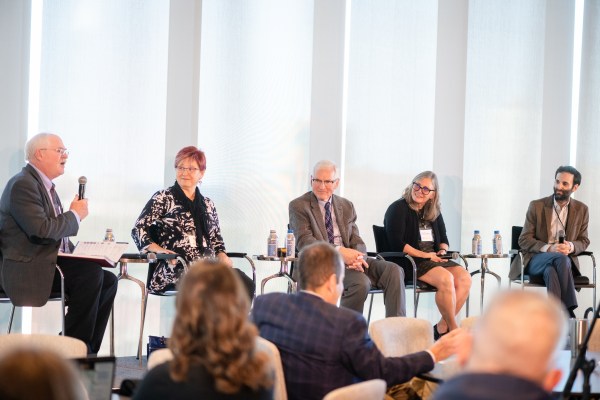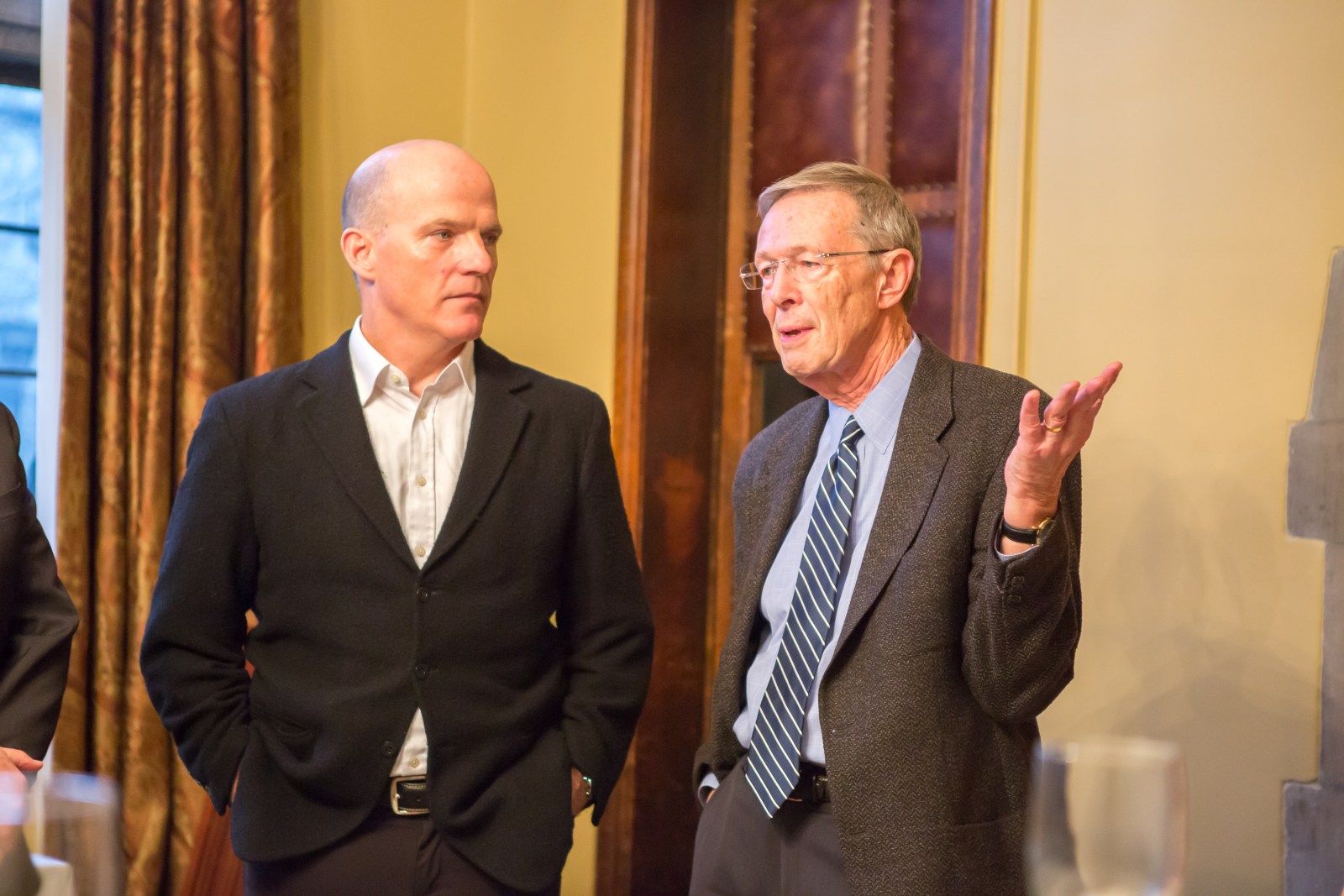
What does it truly mean to be yourself? In this powerful conversation between Charles Newell, Artistic Director of Court Theatre for 25 years, and Harry L. Davis, Professor at the University of Chicago Booth School of Business for 60 years, we explore the deeply personal and transformative work of accessing one’s authentic self.
Q&A
Harry: When you work with actors or with executives and students, to what extent do you think they really know who they are?
Charles: That’s a great question because aren’t we all on a lifelong journey about trying to figure that out?
Maybe this is too simplistic, but once we go through the maelstrom of adolescence I think we start to have a sense about who we are or what feels right about ourselves. Wherever you are on that journey there’s so much power in tapping into your self-awareness, self definition or self identity. Only you will know when it really feels like you are being your “most authentic self.” It’s really quite an emotional thing when that happens.
Harry: Terms that are used frequently are the desire to be authentic or getting in touch with my true self. Is there such a thing as my true self?
Charles: Yes. People often have an idea about what it means to be authentic or what it means to be true to oneself — I’m honest, I’m loyal, I’m trustworthy. These are qualities that are more aspirational rather than inherent. I do believe there is a sense of a true self but only through practice and reflection does one begin to understand what that is. One of the way-stations along that journey would be to ask: How do I find my calling in life? Why am I here? What purpose could I fulfill in the time that I have? I’ve found that the more someone really confronts those questions, the stronger sense they will have about who may be their true self given their mission in life and their calling for ”Why I am here and not somewhere else.”
Harry: I find aspirational ideas really exciting. At the same time, I wonder the extent to which people are afraid or uncertain about heading toward these very aspirational goals. What do you see as the obstacles?
Charles: There’s always self doubt and no one is harder on themselves than they are. I’m certain that’s true for me. I think the major obstacle is again the belief that there is a way that I should be and therefore I’m afraid to do this work.
I think there’s also a fear that maybe I don’t really know the answer. What if I really don’t know what my mission is, what my calling is, what my purpose is? If I don’t know my true self, a panic or vacuum of clarity can be really freezing. Those obstacles can be lowered when given the opportunity to be in a safe space to not know.
Just with courage and a leap of faith you can try something. It may not feel right and be right, but with the support of collaborators you just go ahead. You have to just have faith to take the first step. There will most likely be a ledge of rock that holds your weight. That ledge couldn’t be seen before you took the first step.
Questions about the Program?
Harry: Leaders frequently say to their staff that the environment is safe and they should feel free to talk openly. The faculty will say: “This classroom is safe.” I would suggest that a classroom is not very safe. But in watching you, I see and feel that you create a genuinely safe place. How do you do that?
Charles: As a theater director I can define my own calling which is to create a space so that artists can take risks and realize their true expression and true self. A couple of things have been helpful.
At the beginning of working with someone I take a risk myself. I acknowledge my own fears and acknowledge my own nervousness or excitement. I take a risk to be vulnerable and take the risk to step forward into the space so that it might invite others to take steps forward as well. You’re much more likely to take a risk with somebody if they’ve taken a risk first and tested the waters. I prepare myself going into the first encounter. I really ground myself and speak truly from a place of risk, fear and vulnerability. That’s a hard but important way to start.
Another thing is to truly support the person who is stepping forward with you to do the work. It’s incredibly important to be completely present to them so that they feel that. Sometimes this can be overwhelming and a little intimidating. It’s all about really seeing the person, where they’re at, and trying to find what space is open for me to step forward and be with them.
Harry: I’ve noticed over the years that you try to get people who are doing this work to connect to the situation that they want to bring to life. You often ask, “Say a little bit about exactly what happened, where it happened and who were the people in that place with you.”
Charles: As a director there is that voice inside of me that imagines what if this were to happen? This is what I would have said and this is what that other person would say. These scenarios run in our heads and are active all the time in anticipation of the real thing. I could imagine everybody coming into my staff meeting, or I’m giving a presentation at my board meeting, or I’m having a one-on-one conversation with my supervisor.
As part of empowering the person and being completely present for them, I remind them that it’s their show, if you will. The task is to bring forward the scenario that is in their imagination and then make it manifest in the room right now. I say, “You’re the director, you’re the playwright and you’re the actor. You’re the producer, and you’re the casting director for the scenario that you want the opportunity to step forward into. Who’s in the room with you? What is the goal that you want to achieve? What do you need from the people in the room? What kind of responses or energy do you want to get from them?” Often they’re basing the answers to these questions on some past experience that did not go well. They’re trying to change it. In order to do that you need all of those in the room to bring their energy helping create the opportunity for the person to bring forward a different kind of leadership and reactions from others than had happened in the past.
I try to call everyone to listen to what the person actually says — what words, phrases, and language do they use. What I mean by that is, memorize what they said. If you’re the student working, it’s incredibly powerful to then hear back from others the exact words that were said. Hearing those words coming back to you is reinforcing. That is not just because somebody was really listening, but rather what I said is what we’re going to do. What I said is legitimate and how I defined it is what we are doing. “I am really the playwright; I’m really the director!” I also ask everybody who’s helping facilitate and support the person who is working to listen very carefully to pick up on any descriptors or ways in which the person has defined the situation. The more we can all collectively be specific about what the person has said they want to do, and then reflect that back to them, the greater the chances of success and real movement for growth and enlightenment.
Harry: One issue I frequently grapple with is the emotional impact of making mistakes or having things not turn out well when they do take a risk and try a new way of approaching a situation. How do you deal with that when your work with someone doesn’t seem to help them get to an outcome that was truly enlightening? How do you deal with their reaction? And also, how do you deal with this outcome yourself?
Charles: There’s a very intuitive and delicate balance about when to keep pursuing, refining and improving the role that I’m playing. Sometimes it can be the smallest little thing that you missed or some clue that’s possibly still in the air. Had you taken another breath or another moment, they might speak it or find it. You can’t really predict and I always operate at that point. When I’m doing the work, the whole rest of the room goes away. I am in a place of incredible focus and am fully present with that person. I am doing everything I can not to think about if there’s a way it should be or what’s the problem. I really just try to stay in an intuitive place to react.
Harry: You said earlier that becoming closer to one’s true self and being more authentic requires a lot of practice. Surprisingly, in just watching you and the other person in those practice moments I often find some meaningful things for my own life.
Charles: I think there’s a great opportunity for growth and change by observing others. I’ve spent decades trying to pick up on the smallest energy shift or physical shift just in terms of how I experience and then respond to what I see. I’ve been stunned by the observations that others bring forward in describing their experience when watching the person who is working. They feel the authentic energy and power that’s happening. They are drawn to watch with intensity because there’s something going on in their own process based on what they’re seeing. We’ve struggled, you and I, about how do we provide this opportunity for self-discovery for more people. It’s very intense one-on-one work, and I don’t think that can be changed. I guess we should not forget how impactful it can be to just be in the room participating and observing another person working.
Harry: Given the task of giving more people opportunities to experience this journey toward authenticity, can we find or train people to operate like you do?
Charles: Unequivocally. I believe that if anyone tried to be Harry or Charles it would not be successful. Alternatively, we need to create and implement a transference process that is unique to each person. It must be grounded in some of the same principles but still allow freedom for many unique expressions.
At its heart, this conversation is a reminder that life, like acting, is not about performance but presence. Through My Life Studio, Charles Newell and Harry Davis invite individuals to step into a space of intentional reflection, experimentation, and self-expression. The work is not about finding the “right” way to lead, speak, or show up but about discovering the way that is most uniquely and powerfully your own. With care, courage, and community, participants are supported in taking those first uncertain steps toward authenticity that, once taken, can lead to lasting transformation both on and off the stage.
Curious how this work comes to life in a guided, supportive environment?
Learn more about MyLife Studio, the 7-week in-person course here.