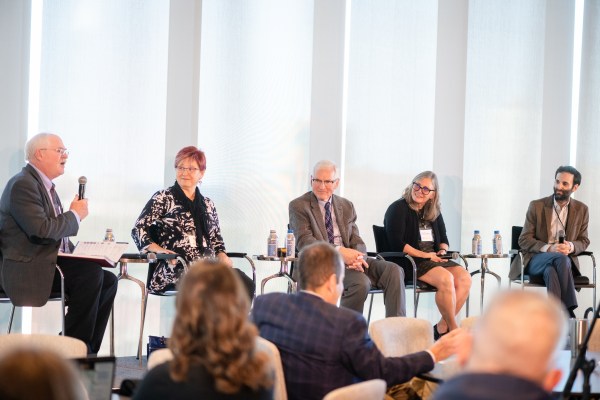
We’re pleased to share reflections from Matt Welton, the Graham School’s Assistant Director of Travel Studies, on his recent journey to Dublin, where he explored the world of James Joyce.
Earlier this fall, Matt brought a group of Graham students and alumni to Ireland for James Joyce’s Dublin, an eight-day Travel Study experience created in partnership with The James Joyce Centre. Together, they walked in the footsteps of Leopold Bloom and Stephen Dedalus, visiting the streets, beaches, and landmarks that inspired Ulysses, Dubliners, and A Portrait of the Artist as a Young Man.
Guided by Joyce scholars and Graham instructor Kendall Sharp, the group engaged in lively discussions, gaining new insights into Joyce’s works and Ireland’s literary heritage. The itinerary also included a day trip to the Boyne Valley, a UNESCO World Heritage Site, offering a deeper connection to Ireland’s Gaelic past.
Matt shared his reflections on what it was like to bring this group of travelers together learning alongside one another, immersing themselves in Joyce’s world, and discovering how travel can deepen understanding and spark meaningful conversation.
Read below to learn from his insights.
Walking through Jame’s Joyce’s Dublin
Matt Welton, Assistant Director of Travel Study
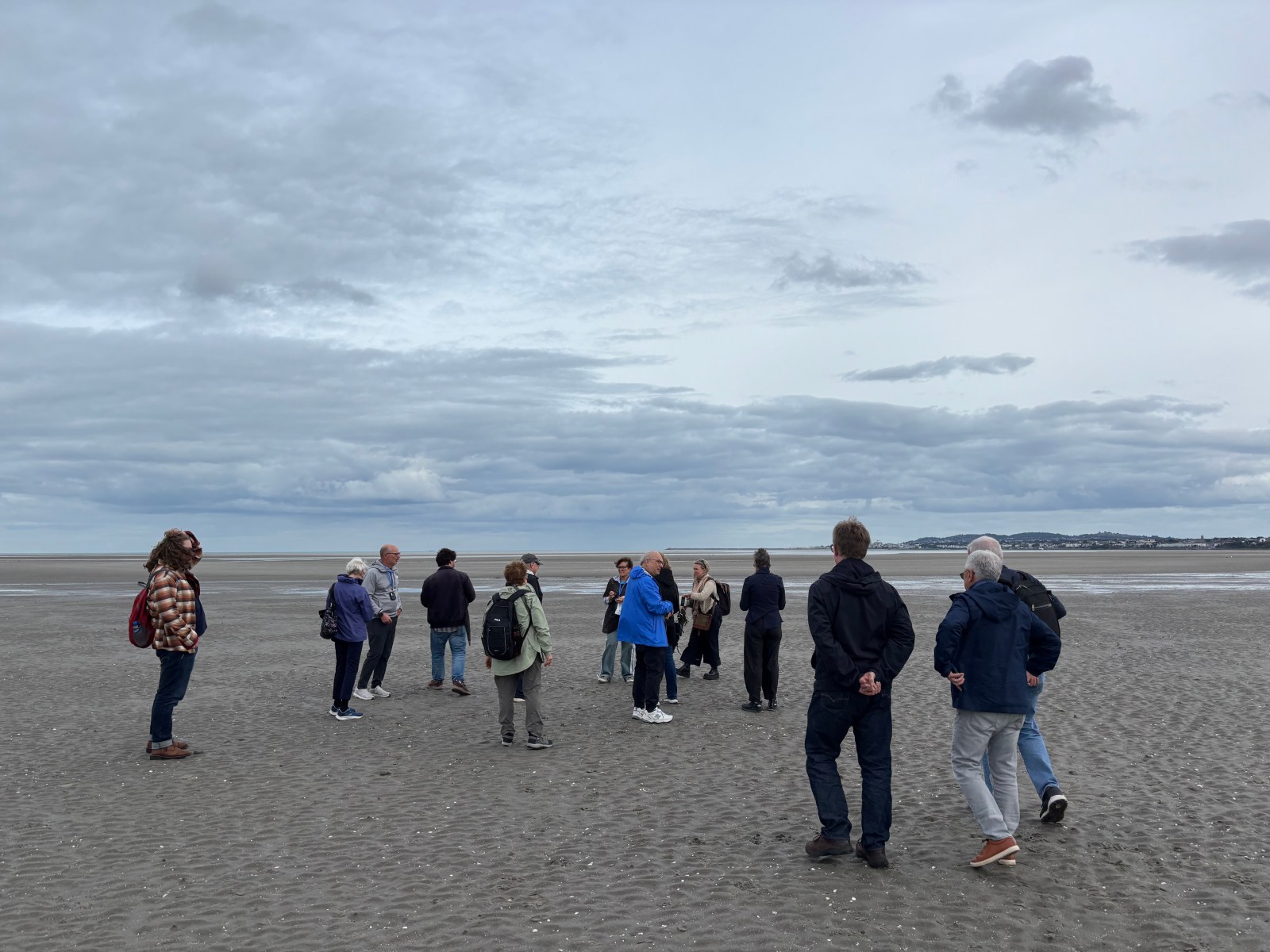
It’s not the flat expanse of low tidal beach with the industrial smokestacks in the distance that inspire the travelers to take out their cell phone cameras; it’s the music of the text. Some watch with smiles on their faces, transported two-hundred-and-twenty plus years in the past. They are excited because they are finally getting the true and simple meaning of a challenging text, and it’s coming out crystal clear in the delicate brogue of the woman who reads. Other travelers record the moment so that they can replay and re listen back home, when they sit in a favorite chair with fingers scanning deep across line 340 in Chapter 3 of Ulysses: “unfurling many crests, every ninth, breaking, plashing, from far, from farther out…”
A few nights later, we gather as a group on the second floor of a Georgian townhouse and witness two actors lost in a pair of monologs from Dubliners. We are surrounded by ornate plasterwork and molding of the period, and as one of the actors in full cravat twists his face and voice to match the pleas of a child and then relaxes back again to assume the fierce bleating of a father it feels as if we are time travelers once again, voyeurs to a private moment right before it’s set down and immortalized in prose.

The site where Leopold Bloom, James Joyce’s hero of Ulysses, sets out on his day long walk around Dublin is now a brick wall in a medical center. It is an unassuming wall, set back from a street where tourists don’t usually venture down. Kendall Sharp, our Graham School instructor and tour leader, holds court on the sidewalk, pointing to a plaque marking the spot. Students stare, the wheels of their imagination working overtime to block out the modern ambulance pulling up, going deep into their memory of the text to draw the door frame of 7 Eccles along the brick. Kendall then tells us all to turn around and shows us a row of Georgian houses across the street, their doors painted the same way they were on Thursday, June, 16, 1904, a half real, half fictional day when Bloom stepped out of his house and crossed to the bright side of the street, avoiding the loose cellar flap of number seventy-five.
Interested in Travel Study?
Over the course of six days, our group of 18 Graham students cover miles of Dublin streets, the entirety of Bloom’s walk. We are joined by the director and staff of The James Joyce Centre as they point out spots where Joyce’s characters throw biscuit tins and roll about in rhododendron. Each morning, we discuss the text sitting in a circle at the Joyce Centre. Each evening, we search the pubs for the faces of the characters of the words. Lining up to cram into a small pharmacy, Sweny’s, to buy a piece of lemon soap is more exciting to this group than a private tasting at the Guinness Storehouse could ever be.

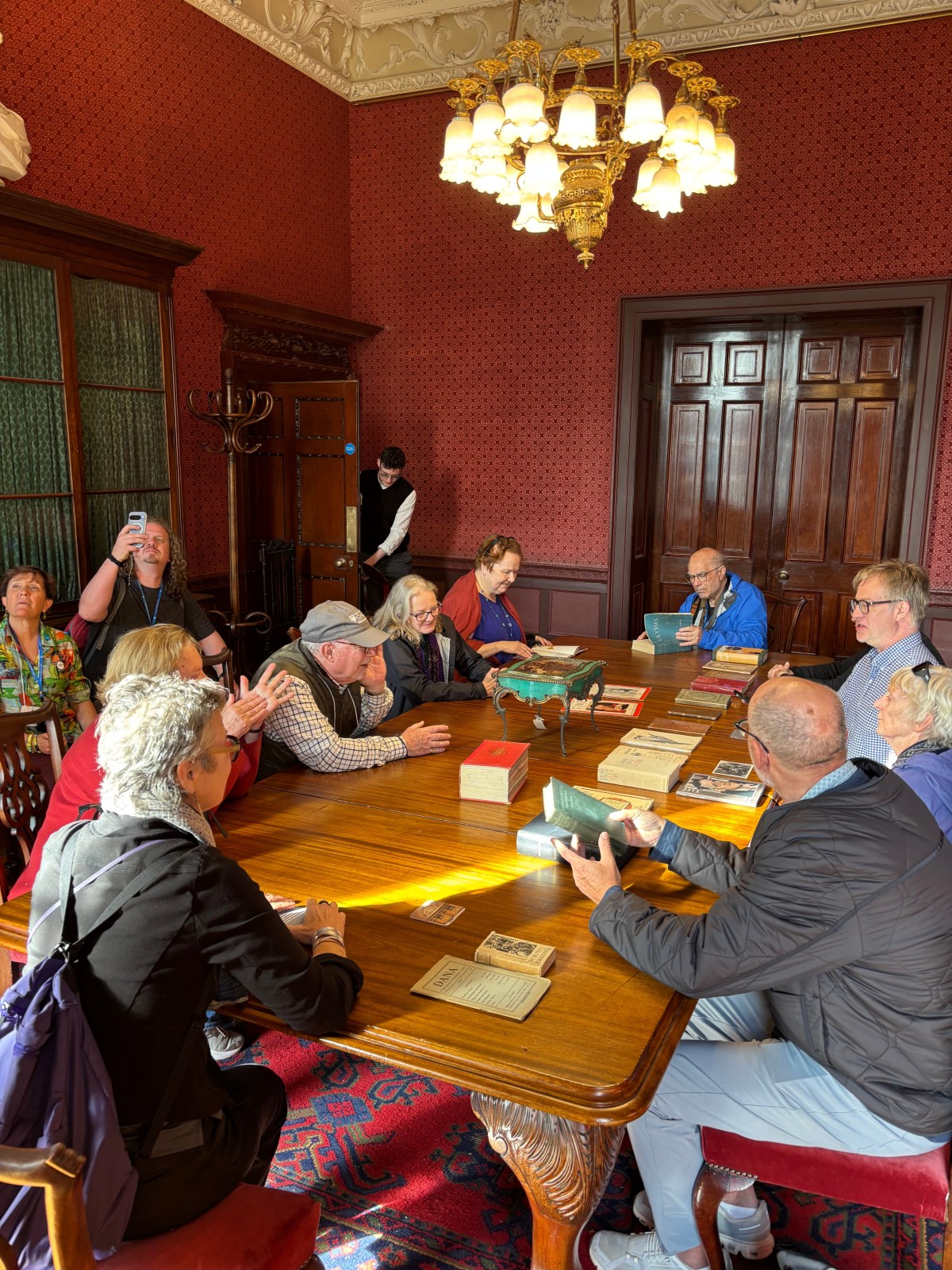
We spend the week breathing Joyce. Every spot we visit opens up his life and his imagination. We gain access to the school he attended as a boy, the uniformed students wondering what we’re snapping photos of as they walk in and out of the auditorium and chapel, a new generation off to daydream the morning away. A guide at the Museum of Literature unlocks a secret passageway, opens a hidden door behind a painting of a stiff collared headmaster, and we navigate a winding staircase that opens into a room where a century ago, a young Joyce failed to impress his peers during one of his first impassioned recitations of an ever changing manifesto. At the National Library we stand before a table with letters written in the author’s hand; we struggle to read the lines scribbled too quickly in the heat of a publishing fiasco. We marvel at the diagrams sketched in a notebook containing the origins of chapter six. Throughout the tour multiple people place first editions of Ulysses in our hands. By the end of the trip, we will have come face to face with what seems to be 75% of the copies still in existence.
Through the entire experience, we talk together as a group. We experience everything with the same eyes, lenses tinted the haze of Ulysses. We not only grow to understand the text better than we ever could have hoped, we rely on each other along the way, to latch on to various observations, and to revel in the raising of a pint, be it Guiness or pop, at the end of the day. On the last night, several students dance in a circle to the mad dashing of a fiddler and a pipe. Dublin, beyond Joyce, inspires us to anticipate the next location where we will find ourselves together alongside new explorers, diving into another culture, another location, off the tourists’ traps, wandering about the streets and sites that influenced the world’s greatest books.

Learn more about our Travel Study programs and the immersive experiences they offer and explore upcoming trips to see how you can engage deeply with new places, ideas, and perspectives.